NewsLetter
July 2026 | Volume 8 | Issue 2
* Click on Topic to Read

A Milestone Year for SNHPE: Building Bridges among Health Professionals
1,2Raju Srivastava
1Professional Development Director, Society of Nepalese Healthcare Professionals in Europe (SNHPE)
2Expert in Medical Radiation Physics, Universitair Ziekenhuis Gent, Belgium.
The Society of Nepalese Healthcare Professionals in Europe (SNHPE) was established in August 2024 with the mission of fostering professional collaboration, academic exchange, and career development among Nepalese healthcare professionals across Europe. The Society aims to facilitate or organize networking events; deliver educational and professional development programs; and support initiatives that strengthen the healthcare sector in Nepal through strategic partnerships and collaborative projects.
Uniting clinicians, nurses, public health experts, biomedical scientists, researchers, allied-health practitioners, and students, SNHPE operates as a non-profit, non-political, and professionally driven organization. It is committed to supporting Nepali healthcare professionals throughout the European Union and the European Economic Area (EEA/EFTA), while contributing to the enhancement of Nepal’s healthcare system. The SNHPE serves as a dynamic platform for multidisciplinary collaboration and continuous professional development. The Society regularly hosts webinars and academic events featuring experts from both Europe and Nepal, promoting the exchange of clinical knowledge, scientific innovation, and health-system best practices. Through mentorship initiatives and networking opportunities, it provides structured support for early-career professionals and students as they advance through their educational and professional pathways.
On 9–10 August 2025, the Society successfully held its First Ordinary General Assembly in Amsterdam, The Netherlands. The assembly was inaugurated by H.E. Ms. Sewa Lamsal, Ambassador of Nepal to BENELUX and the EU. Thirty-six participants from various European countries attended the assembly, which featured clinical, scientific, and IT sessions, along with literary and musical programs.
Attendees also enjoyed a traditional Nepali dinner accompanied by musical performances by the executive board members and others. During the assembly, Prof. Dr. Ganesh Acharya, MD, PhD, FRCOG from Sweden, was honored with the Nepalese Healthcare Professional of the Year 2025 Award in recognition of his outstanding contributions to medicine.

In his address, Prof. Acharya reflected on his journey from rural Nepal to becoming a leading figure at one of the world’s top university hospitals. The award will be presented annually to Nepalese health professionals in Europe who have demonstrated exceptional contributions in medicine, nursing, or health-science research.

As part of its commitment to celebrating excellence in healthcare, the Society has also introduced the Europe Nepal Health Award. This award recognizes individuals, groups, or institutions that have made significant contributions to improving healthcare delivery in Nepal or advancing the professional rights of Nepali health workers. The award includes a certificate and a monetary prize of NPR 100,001. SNHPE has selected the Nepal Medical Association (NMA) as the inaugural recipient, acknowledging its dedicated efforts, advocacy, and achievements in securing improved rights and allowances for resident doctors in Nepal in 2025.
Looking ahead, SNHPE is delighted to announce the launch of the European Journal of Nepalese Healthcare Professionals (EJNHP) – a biannual, online, open-access journal aimed at providing a rigorous, peer-reviewed platform for high-quality research, case reports, and scholarly work relevant to clinical practice, public health, and healthcare systems. The first issue is scheduled for publication in May–June 2026. The journal welcomes submissions of original research, review articles, case reports, and academic contributions from healthcare professionals and researchers across disciplines and regions, with a commitment to nurturing a vibrant and diverse academic community.
The Society of Nepalese Healthcare Professionals in Europe looks forward to continued coordination, cooperation, and collaboration in advancing its mission. The Society warmly welcomes eligible Nepalese healthcare professionals across Europe to join its membership and contribute to its shared goals.

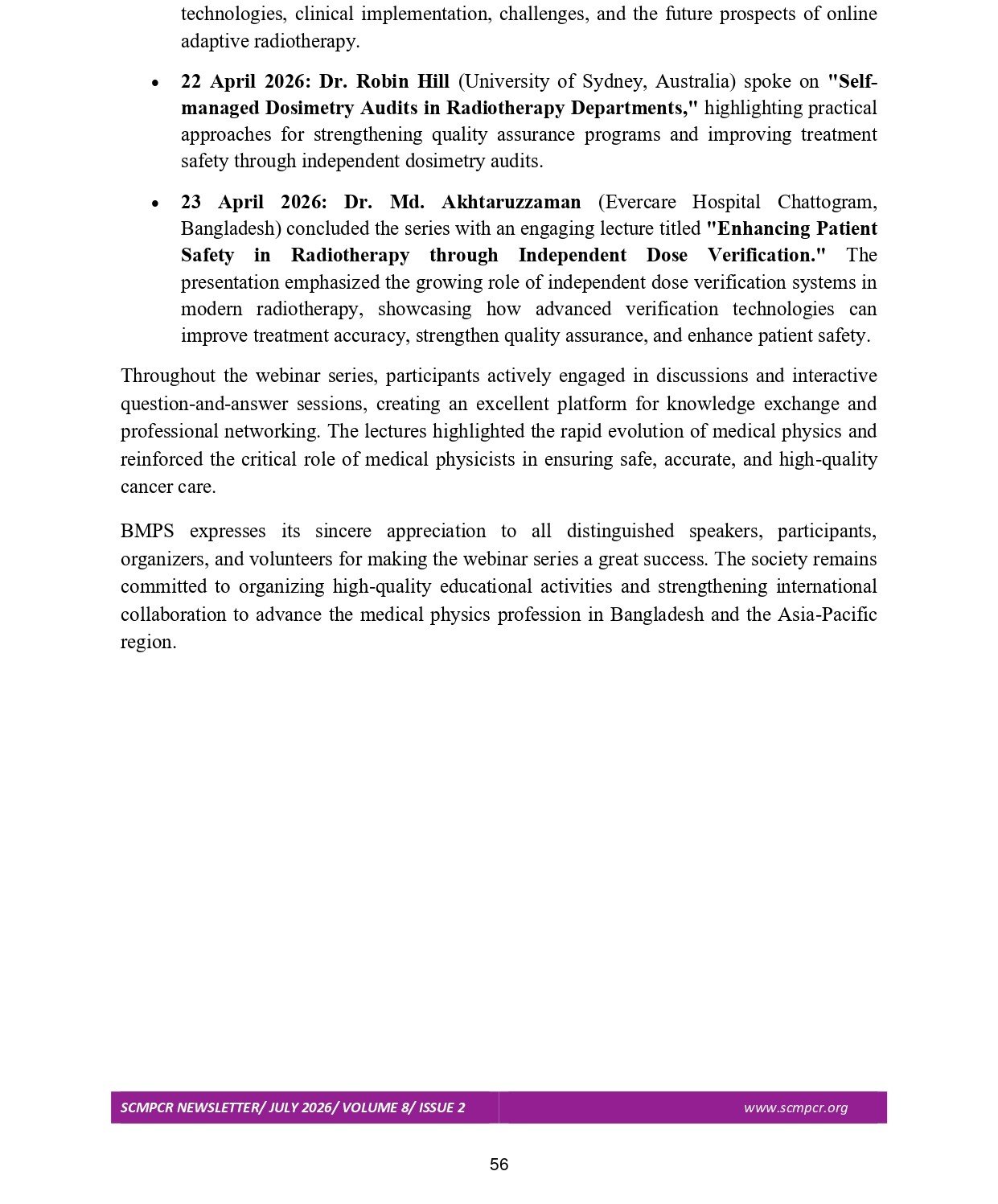
BMPS President appointed as AFOMP Education & Training Committee Chair
It is a matter of great pride and pleasure for the Bangladesh Medical Physics Society (BMPS) to announce that Dr. Md. Akhtaruzzaman has been appointed as the Chair of the Education and Training Committee of the Asia-Oceania Federation of Organizations for Medical Physics (AFOMP).

This prestigious appointment reflects his longstanding contributions and leadership in the field of medical physics, both nationally and internationally. Dr. Akhtaruzzaman has been serving BMPS since its inception in 2009, holding various key executive positions over the years, and currently serves as the President of BMPS. Under his leadership, BMPS has expanded its academic and professional activities, fostering collaboration, capacity building, and educational advancements in medical physics across Bangladesh. Within AFOMP, Dr. Akhtaruzzaman has made significant contributions as a member of the Science Committee, Education and Training Committee, and Publication Committee.
His new role as Chair of the Education and Training Committee further recognizes his dedication to advancing professional standards and promoting high-quality education and training programs for medical physicists across the Asia-Oceania region. BMPS congratulates Dr. Md. Akhtaruzzaman on this remarkable achievement and wishes him continued success in his efforts to strengthen medical physics education, research, and professional development globally.

Medical Physics Day 2025 at AECH (NORI), Islamabad, Pakistan
Islamabad, Pakistan-November 22, 2025: Energy Commission Hospital (AECH), NORI Islamabad hosted Medical Physics Day 2025 with a full-day program that combined opening remarks, two technical sessions, poster session and Q&A segment.

The event opened with registration, followed by a formal inaugural session that included Holy recitation, the National Anthem, and welcome remarks. The session also highlighted the importance of the International Day of Medical Physics. Attention was drawn to the vital role medical physicist’s play in modern healthcare. Emphasis was placed on patient safety, quality assurance, and the growing responsibility of the profession in advancing clinical practice.
First Technical Session: Clinical Practice, Safety, and Advanced Planning
The first technical session focused on strengthening clinical practice and supporting the growth of medical physics in Pakistan through quality, safety, training, and research. Topics included “Introduction to POMP, where do we stand” and “Strengthening Clinical Practice through Implementation of Peer Review Practice in Medical Physics.”
The session also covered patient protection and internal dosimetry, along with technology and treatment-planning themes. Presentations discussed internal dosimetry and patient protection, innovations in isotope production, and treatment techniques such as SFRT using grid. Research oriented talks highlighted precision methods and computational tools, including personalized internal dosimetry of [¹⁷⁷Lu] Lu-hydroxyapatite for radiosynovectomy, efficiency analysis of spine SBRT across platforms, and a Python-integrated TOPAS framework for compensator design and variable RBE analysis in proton beam therapy.
A dedicated Q&A and poster display followed, allowing participants to engage directly with the presented work before the lunch break.
Second Technical Session: Measurement, Emerging Modalities, and Future Directions
The second technical session highlighted practical measurement workflows, advanced modalities, and future-facing tools for clinical and research use. It included work on CyberKnife beam characterization, such as measurement of off-center ratios (OCRs) using Gafchromic EBT3 films for variable apertures.
Emerging and advanced treatment approaches were also discussed, including accelerator-driven BNCT for cancer care and Monte Carlo–based investigations such as Geant4 dosimetric analysis for radiotherapy in patients with specific implants.
The session further explored digital transformation in the field through Generative AI-based medical physics reference applications, and it addressed the future trend of dosimetry audits in Pakistan, emphasizing the role of independent verification and continuous improvement in patient safety.
Community Impact and Closing

Programs like this strengthen the medical physics community. They create a shared space for learning. They also help connect clinical needs with research ideas. When medical physicists discuss peer review, dosimetry, advanced planning, and audits together, the whole system becomes safer and more consistent.
The event concluded with participant comments, concluding remarks, and a formal summary and appreciation for attendees and contributors.

The KYAMCH Cancer Center Marks International Day of Medical Physics (IDMP) – 2025 by Emphasizing the Emerging Technology
Parvez Mosharaf1, Md. Imrul Kaes2
1Dept. of Oncology & 2Dept. of Pediatric Haematology & Oncology
KYAMCH Cancer Center, Enayetpur, Sirajganj, Bangladesh
On November 07, the Medical Physics Division of Khwaja Yunus Ali Medical College & Hospital (KYAMCH) Cancer Center proudly celebrated the International Day of Medical Physics (IDMP) 2025. The event took place at the Dr. M. M. Amjad Hussain auditorium, where a full day of academic discussion revolved around the global theme: “Medical Physics and Emerging Technologies: Shaping the Next Decade”.

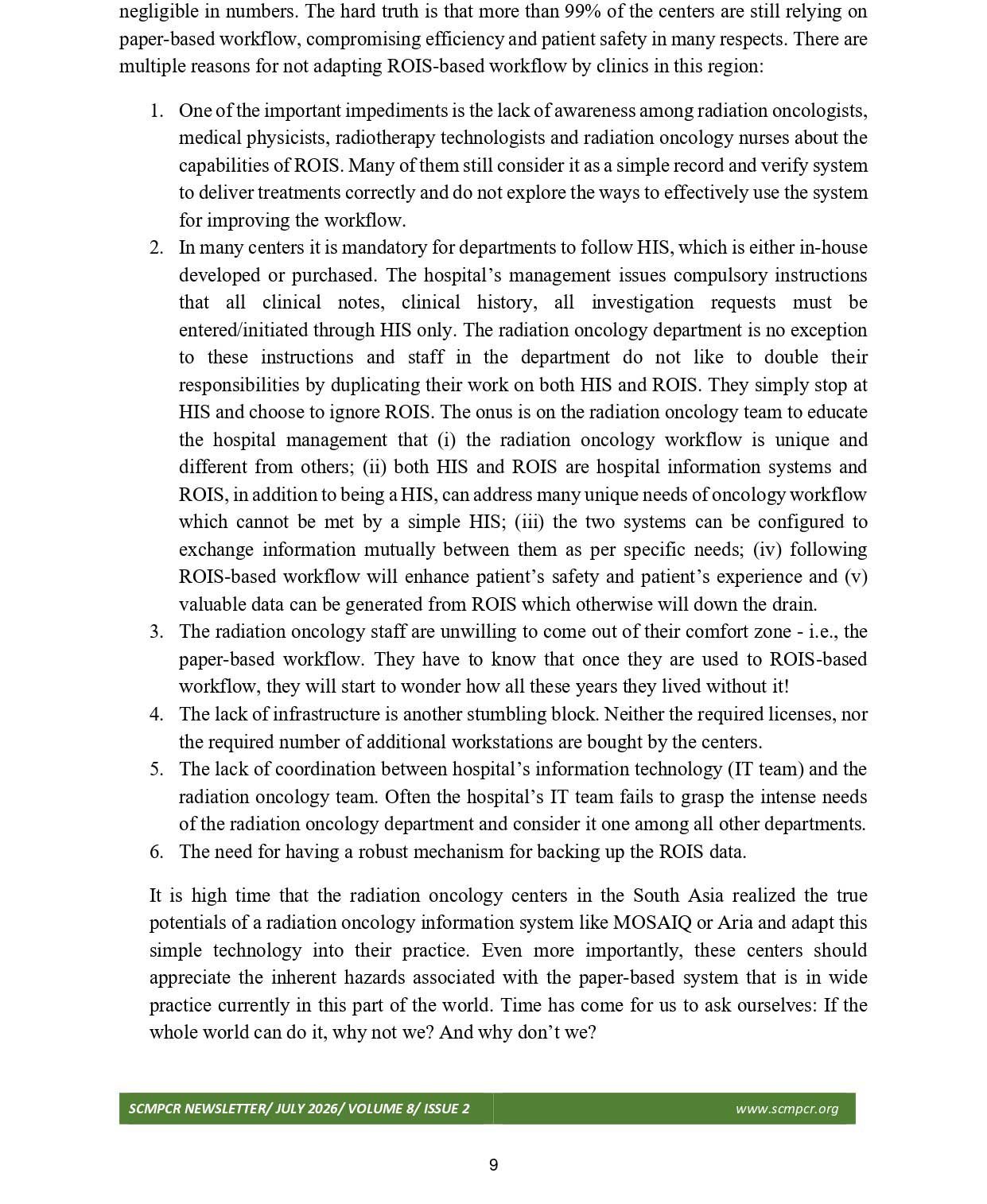
The gathering showcased esteemed speakers, including a virtual keynote from Prof. Dr. Golam Abu Zakaria, a trailblazer in medical physics education in Bangladesh. He accentuated “New Aspects of Medical Physics in radiation Oncology and Imaging” and also emphasized the importance of qualified Medical Physicist to ensure accuracy & safety in healthcare. Alongside, the event was graced by in-person presence of Prof. Dr. Hasin Anupama Azhari, President of the Asia-Oceania Federation of Organizations for Medical Physics (AFOMP). She highlighted “Structure, Aims and Functions of AFOMP”. Both speakers also underscored the urgent necessity for enhanced academic training and adherence to international standard in radiotherapy.
Conversations during the event illuminated the changing landscape of medical physicist’s role within multidisciplinary cancer care. The program culminated in a ceremony that celebrated excellence in radiotherapy treatment, reinforcing KYAMCH’s dedication to clinical precision. The session featured by Md. Yusuf, Honorable Society Director of KYAMCH, as the chief guest. He advised “Work together and be a hope for cancer patient” and also gave his heartfelt appreciation to all medical physicist’s whose work silently powers the precision and progress of modern medicine.
Founded in 2007, by visionary legendary Dr. Mir Mohammad Amjad Hussain, the KYAMCH Cancer Center proudly upholds its reputation as a frontrunner in regional oncology, having pioneered the first LINAC services beyond the capital city. KYAMCH Cancer Center believe that oncologists, medical physicists, technologists, nurses together is a team, all of their dedication and compassion ensure world-class cancer treatment even in a resource-constrained environment.


Solve it!!

SCMPR Newsletter is carry a new column – SOLVE IT! – featuring a relatively difficult question / interesting problem for the young medical physics students and young medical physicists to solve. Those who are interested can send their answers to sptgnadar@gmail.com . The best answer would get published in the next issue of the Newsletter along with the name and affiliation of the contributor.
In a conventional C-arm linac which has a maximum field size of 40 cm x 40 cm, the corners of fields larger than a certain size are clipped. See the picture below of a 40 cm x 40 cm field. The corners of the field are clipped

Questions:
1) Which is/are the component(s) in the linac head responsible for the clipping of the radiation field corners?
2) What is the largest possible square field size that can be obtained without its corners clipped? Explain your answer using the linac head geometry.

Solution: Problem (July 2025/ Volume 7/ Issue 2

1. A patient has to be treated by a direct 6 MV posterior spinal field of size 6 cm (width) x 48 cm (length) at an extended SSD of 120 cm. The prescribed dose is 1.8 Gy at a depth of 5.5 cm.
Data (output at dmax for 100 cm SSD, TMR) are given in the tables below. Using ONLY the data given in the tables, find out the treatment MUs.
Note: For equivalent square field, use the formula: Side of the square = 4*(area/perimeter)


Please see Figs 1, 2 and 3
Field size at the extended SSD 120 cm = 6 cm x 48 cm
Field size at the treatment depth of 5.5 cm (i.e. at 125.5 cm from source) = 6.3 cm x 50.2 cm
Field size at the nominal SSD 100 cm = 5 cm x 40 cm
To use TMR data, the relevant geometry is Fig 2 and 3. The ratio of dose at the treatment depth of 5.5 cm to the dose at the same point with only dmax thickness of overlying tissue (i.e., the dose at red square in Fig 3 to the dose at the red circle in Fig 2) is the TMR for the field size of 6.3 cm x 50.2 cm. The equivalent square is 11.2 cm x 11.2 cm. The TMR (11.2 cm, 5.5 cm) = 0.9086.
To know the output at point P (the red circle) in Fig 2, we need to know the output at the dmax depth (yellow circle) in Fig 1.
Output for the field size of 5 cm x 40 cm (eq. sq = 8.9 cm) at 100 cm SSD = 98.6 cGy/100 MUs
Applying inverse square law, 98.6 cGy/100 MU * (101.52/125.52) 64.5 cGy/100 MUs at P (red circle)
The dose rate at the treatment depth (red square in Fig 3) = 64.5 cGy/100 MUs * 0.9086
= 58.6 cGy/100 MUs
To deliver a dose 180 cGy the required MUs = 100 MU/58.6 cGy * 180 cGy = 307 MUs

SCMPCR Newsletter Submission Guidelines
The following guidelines are provided to ensure consistency, clarity, and smooth compilation of the Newsletter.
All contributors are requested to follow these requirements strictly.
1. Overall Length
- Maximum total pages of the newsletter: 30 pages
2. Types of Submissions & Page Limits
A. SCMPCR Report
- Maximum length: 3 pages
- Maximum number of photographs: 4
- Photos must be submitted separately (not embedded in the document), each with a clear caption.
B. General Articles
- Total allocation: 3–4 pages
- May include maximum two general articles depending on length.
- Photos, tables, graphs must be sent as separate files with proper captions.
- Must follow APA reference style
C. Scientific Articles
- Maximum: 5000 words per article
- May include maximum two scientific articles depending on length.
- Photos, tables, graphs must be sent as separate files with proper captions.
- Must follow APA reference style
D. News & Events
- Maximum length: 1 page
- Maximum photos: 1 photo with caption (to be submitted separately)
- Should focus on recent, relevant activities or announcements
E. Awards & Honors
- Maximum length: ½ page
- Must include a photo of the awardee(s) submitted separately
- Include award title, date, venue, and a concise description (50–100 words)
3. Formatting Requirements
- Font: Times New Roman
- Size: 11 pt
- Line spacing: Single
- Submit in Word format (.doc or .docx)
- Do not apply any special formatting, columns, or layout—the designer will format accordingly.
Tables, Figures & Photos
- Must be submitted separately as image files (JPEG/PNG/TIFF preferred)
- Do not embed inside Word files
- Each table/figure/photo must have:
- Caption
- Numbering (e.g., Figure 1, Table 1)
4. Referencing
- All references must follow APA Style (7th Edition).
- Ensure accuracy and completeness before submission.
5. Authorship and Submission Ethics
- Write-up must not be generated by AI.
- AI may only be used for language editing, proofreading, or grammar correction.
- Authors are responsible for ensuring:
- Originality of the content
- Accuracy of data and references
- Proper permission for any photos used
6. Submission Checklist
Before submitting, ensure:
- Word file in 11 pt Times New Roman
- No embedded photos or tables
- All images/tables sent separately with captions
- Word count and page limits followed
- APA references checked
- AI-generated content not used for writing the article
- Author name, designation, affiliation, and email provided